


Share this with your search vendor when multiple round of searches lead to nothing
Many a time, even after multiple rounds of searches – in house, from the client’s side, and using vendors – leads to no results. One reason it happens because the winning prior art is unsearchable or in other words doesn’t come up using the keyword-based searches.
We have found ourselves in such a situation multiple times. In one instance, we found a lead in the citations of a research paper. Going through the lead we found another relevant reference and in citations again – a scanned PDF document. It was a winning prior art and not to mention unsearchable using keywords.
Another way to get yourself unstuck from such a situation is by suggesting your vendor look for discontinued products. Let me tell you, looking for such products or systems especially on the exact required concept can be really a daunting task, your search vendor can relate to it.
However, I ought to tell you – this is something that keeps us going when we are performing any search i.e. finding the information which is otherwise impossible to locate. Our grit coupled with our experimental DNA has helped us find prior art in the most difficult cases, simply because we refused to give up.
Below I have shared one such instance where we were able to find system prior art for a discontinued product:
As a part of a prior art search project, we were looking for worksheets and brochures of some products of NexPress before 2004 which was later acquired by Kodak, and the series of NexPress products were discontinued. We tried searching on Google, but the search was not fruitful and a search on the Kodak website didn’t yield any clue either – There was simply no way on the website to trace back the series of the product.
One could say, literally, there was no source where we could get this information. However, we are not the ones who easily give up. We do not just simply say, “If it exists, we will find it.”
We knew there had to be another way. Just because one strategy didn’t work does not mean, another won’t work either. We just had to keep experimenting until we find the desired result.
Search, as we say it, is exploratory. There is no right or wrong strategy. You need to experiment with a lot of things and observe every detail that comes in the way.
That is exactly what we did. We knew that the Wayback machine keeps track of any information that was available on the web, so we thought – why not experiment with it? It might either work or not, we just did not want to leave any avenue unexplored. Looking back, it was a good decision.
We searched the required product name in the Wayback Machine. It not only suggested the websites that contained the product name but also the time range and number of web captures in that time range.
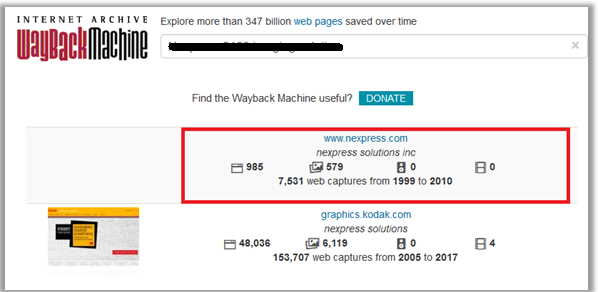
While we cannot disclose the product names and other details for confidentiality reasons, we ought to say that this approach helped us get closer to the prior art. We were able to narrow down to a few websites(screenshot below) and when we traced back to these sites, not only did we get the required brochures and worksheets, but we also got one video showing the required working of the product. Mission complete!
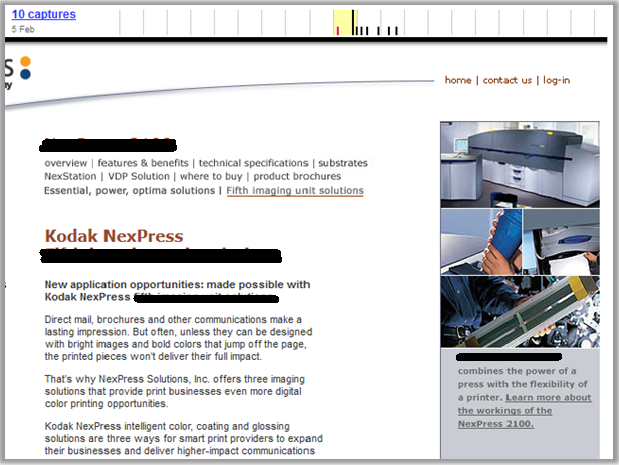
Note – for confidentiality reasons, we have put black marks on the product name.
During our scheduled interim call, we shared this information with the client along with the strategy used to land prior art and he was really impressed.
Sometimes, things that seem too trivial to the eye might get you to places unimagined. In our case, the Wayback machine helped us find spot-on prior art which led to repeat projects from the client. Next time you’re in such a situation where you are not able to find the information regarding any product/technology or you feel the product got discontinued, do give the Wayback Machine a try. It may increase your success rate of finding relevant information.
Another tactic from our little black book of patent strategy. If you’d like to get access to more tactics like this, subscribe to our newsletter where we only share filtered information relevant to you– Subscribe here.
Authored by: Nikhil Gupta, Manager, Search Team.