
Have you considered that by solely performing competitor research based on their online presence and ranking, you miss many innovative companies working on similar technologies?
These companies may have even patented their innovations, which makes them the REAL COMPETITORS to your business. After all, patent data reveals innovators entering your domain at an early stage- way before they make it to Google’s first page. However, it is extremely time-consuming to find all the patents in your domain, deduce insights, and then prepare a list of competitors. So, what if you could find these competitors in less than a minute – backed up by the patent data?
Yes, you heard that right.
In this article, we explore why Google, although widely used, may not be the best option for discovering unique competitors in your industry. And provide a foolproof solution to identify all players in your space without having to scour countless websites.
So, let’s dive right in…
4 Reasons why you can’t rely on Google for competitor research
Understanding competitors, especially those that remain unnoticeable online, helps you uncover market gaps and contemplate collaboration and partnerships. Moreover, smaller, under-the-radar companies usually possess patented technologies, products, or approaches that have the potential to ignite fresh ideas and set your business apart.
However, Google may not always be the ideal tool for discovering these lesser-known players for the following reasons:
- Companies with more substantial marketing budgets often dominate search engine rankings. Smaller or niche competitors might lack the resources to compete effectively for top positions on Google.
- Google’s search results are influenced by complex algorithms that prioritize popular and well-established websites. This bias can lead to smaller or emerging competitors being overshadowed by larger, more prominent ones, making it challenging to identify those under-the-radar players in your industry.
To provide an example, let’s consider the cosmetics industry. If one wants to find out about companies that compete with Beiersdorf, they may conduct a Google search. After gathering data from various websites, a list of competitors compiled will look like this-

However, do you know there are three other innovative competitors that Google did not include in the list? One of them is Symrise, a German chemicals company that is a major producer of flavors and fragrances. As per CompInsight’s CPC analysis, this company has a 69.37% overlap with one of Beiersdorf’s patented technology.
Ignoring the innovation from a company working in quite a similar domain can catch you by surprise. We’ll reveal these additional competitors and their details later in the article.
- Google does not provide competitor information derived from patent data, such as Cooperative Patent Classification (CPC) and citation data. Therefore, you might miss out on valuable insights regarding your competitors’ intellectual property and innovations when using Google alone.
- Google tends to display competitors within the same domain or industry, but it’s crucial to recognize that cross-domain competitors exist and cannot be ignored. These companies may not operate in the same industry but offer products or services that can still compete with yours or disrupt your market.
Closely monitor the budding companies in your domain, which can be dangerous in your direct competitor’s hands

How Patent Citations and CPC helped develop CompInsight for Competitor Research?
Cooperative Patent Classification or CPC classifies patents based on their technical content and the specific technology they pertain to. While internet searches often concentrate on market sentiment and public visibility, CPC offers a different perspective by focusing on the Research and Development (R&D) activities of the organization. Using this data, we have created CompInsight, which uses patent citations and CPC to display the competitors of a company in under a minute.
This means it can help you identify companies actively engaged in innovation, even if they aren’t widely recognized. So, instead of Google, when I used ComInsight to find competitors of Beiersdorf, I found four additional companies (highlighted in yellow) that were not initially identified.
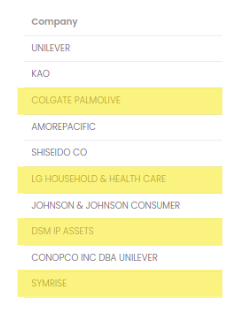
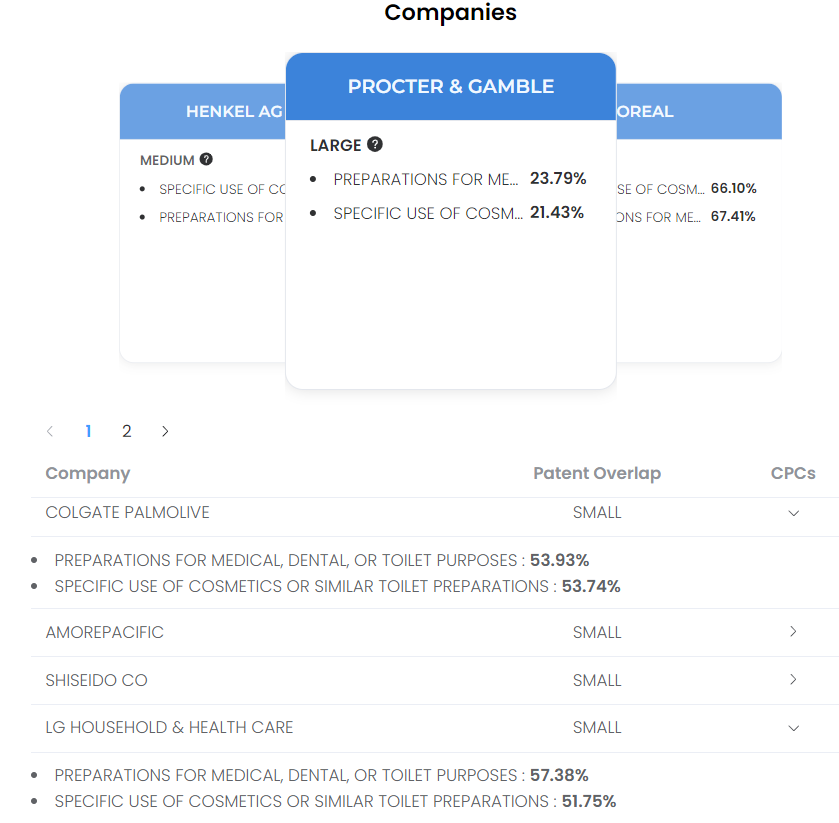
Discovering competitors like COLGATE PALMOLIVE, LG HOUSEHOLD & HEALTH CARE, and SYMRISE, with over 50% patent overlap in areas such as “Preparations for Medical, Dental, or Toilet Purposes” and “Specific Use of Cosmetics or Similar Toilet Preparations,” provides a significant competitive advantage.
This overlap data not only highlights potential rivals that may not have been evident through traditional market analysis but also offers insights into shared research and innovation interests. You can leverage this information to identify collaboration opportunities, evaluate the competitive landscape more comprehensively, and potentially tap into shared intellectual property for mutual benefit.
What sets CompInsight apart is that the tool provides data that is closely aligned with R&D competitors by reflecting on a company’s investment patterns in research and development.
While online sources are valuable for uncovering competitors with similar sizes, activities, products, and market focus, this data primarily reflects companies’ R&D investment patterns.
Therefore, the next time you seek a comprehensive understanding of your competitive landscape, CompInsight is the tool for you.
By the way, do you know the name of the snowmobile company with a patent footprint similar to Honda?
Find it out on CompInsight
Authored By: Roopam Jain, Product Development Team
Edited By: Annie Sharma, Marketing Team