

Creating a patent licensing strategy for circuit patents can be a challenging task. There are rare chances of finding a detailed schematic of products in product literature. This makes identifying products infringing your patented circuitry expensive as well as time-consuming.
But there is little to worry, as I’m about to walk you through a 3-step process that will help you in licensing your patent when at heart of it lives circuitry claims. This is a tried and tested approach. We have used it to identify infringement for circuit-based patents.
A 3-Step Approach for Licensing Patents with Circuits in claim
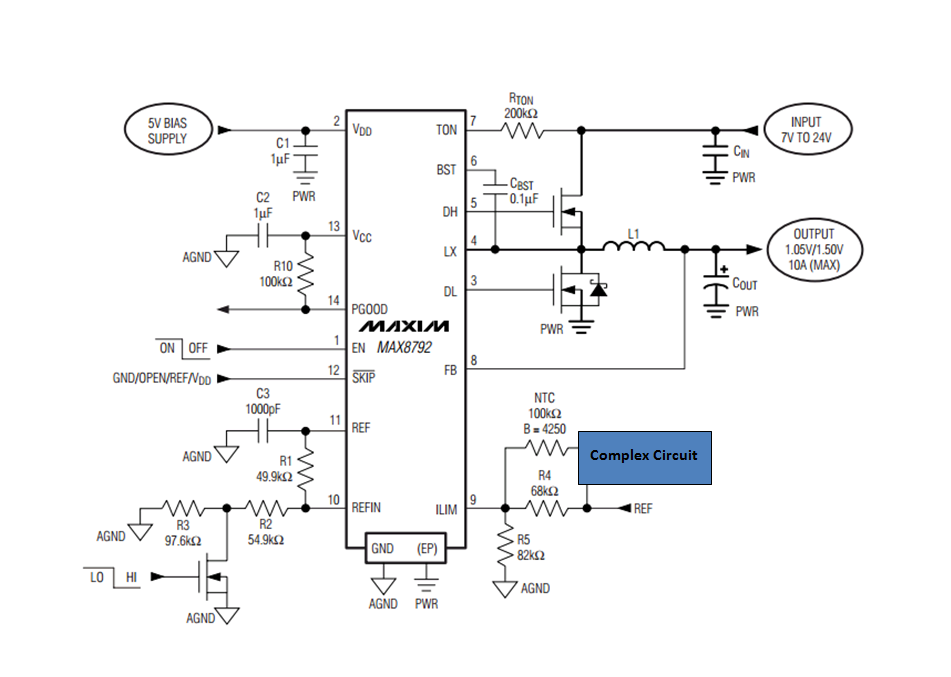
Doesn’t the above circuit look complex at a first glance? By the end of this article, it wouldn’t be the case.
Let’s dive right in to find how the 3-step approach to licensing patents with a complex circuit. For analyzing such complex circuits, we follow the below steps:
- In the first step, we divide the complex circuit into smaller individual blocks,
- The second step consists of an in-detail analysis of each individual block,
- In the third and final step, we interpret the complex circuit and perform further research for potential infringement.
Related Strategy: Patent Monetization Mistakes Most Businesses Are Collectively Making
Step 1 – Dividing the complex circuit into smaller individual blocks
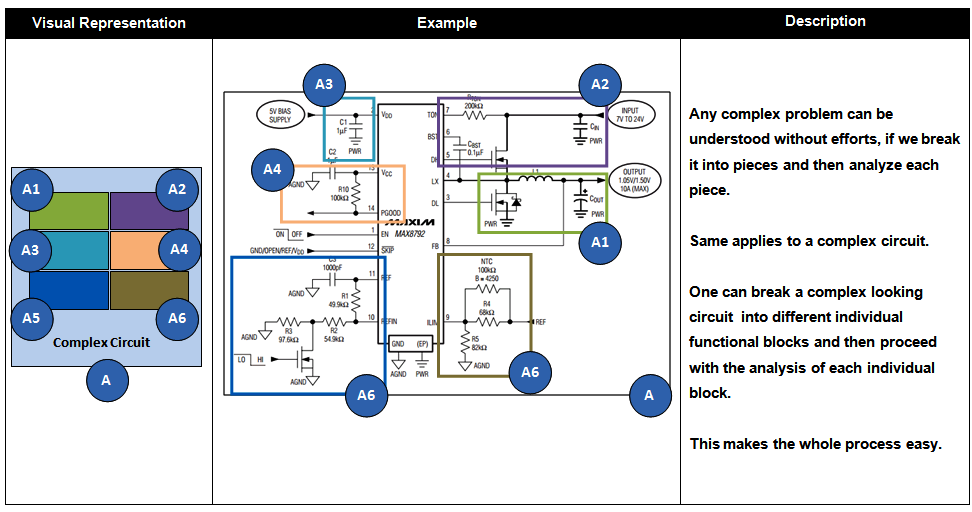
Step 2 – Analyzing each block in detail
In an electronic circuit, multiple circuits can be used to achieve a similar function. Further, different arrangements of same circuit elements or different circuit elements can be used in the same circuit to achieve the same function.
But why we should focus on that? Let us explain this with the help of an example. In the United States, the doctrine of equivalents analysis is applied to individual claim limitations, not to the invention as a whole.
Further, under the doctrine of equivalents, the triple identity test states that the difference between the feature in the accused device and the limitation literally recited in the patent claim may be found to be “insubstantial” if the feature in the accused device:
- Performs substantially the same function
- In substantially the same way
- To yield substantially the same result
as the limitation literally recited in the patent claim.
In the context of circuits, it means that if two circuits perform similar functions, they can be considered equivalent. Hence, in this step, each block is analyzed in detail to form multiple representations which will perform a similar function as the original circuit.
Below is a visual representation of the same.
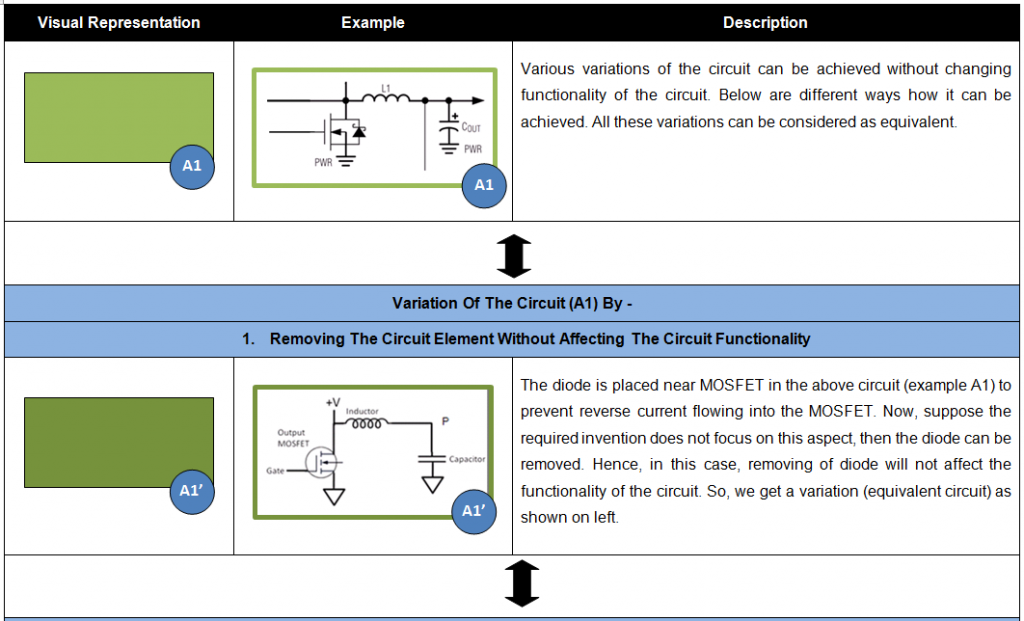
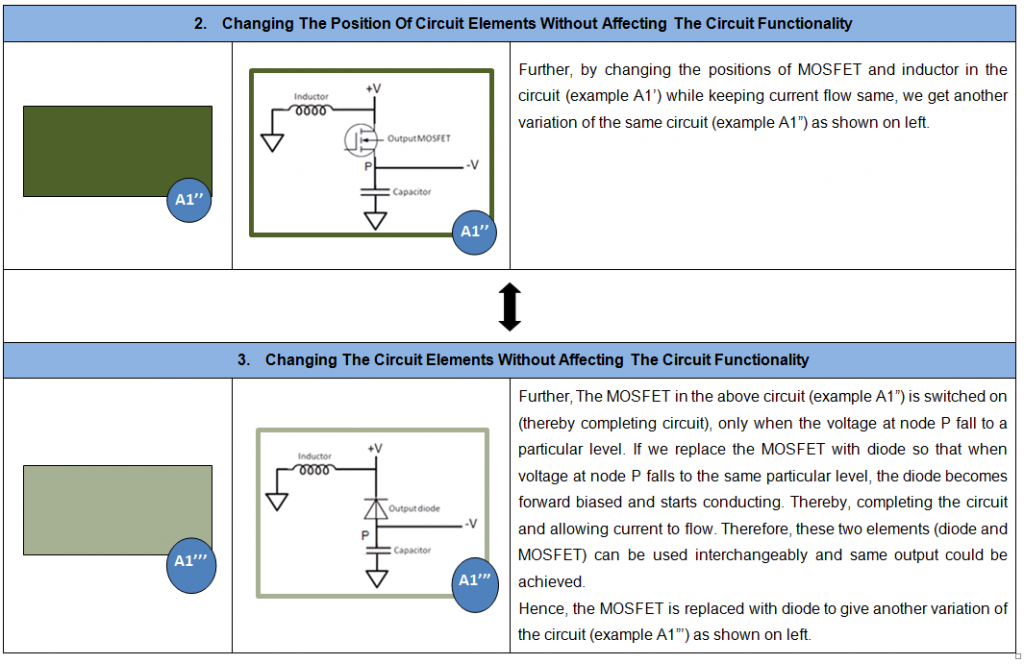
In a similar manner, circuit variations of all the blocks such as A2, A3… are also made.
Step 3 – Interpreting the complex circuit & research for potential infringement
Now, for each block, we have multiple representations which will function in a similar manner. Next, various combinations of the complex circuit are formed using different permutations and combinations of the individual blocks. Thereafter, research is performed to identify potential infringement taking into account all possible variations of the complex circuit.
This three-step approach helps us convert – ‘an arduous research for a complex circuit’ into ‘streamlined research for a not so complex circuit’. Also, it enables us to cover all possible variations and deliver more products infringing patents of our clients which would not have been possible with a conventional approach.
PS: We’d love to hear your thoughts on this 3-step approach. Chime in the comments section below and add to the conversation.
Authored By – Shikhar Sahni, AVP, Operations, Anoop Chauhan, Manager, Infringement Team, and Rohit Sood, Team Lead, Infringement
Suggested Article: How to use Reverse Engineering To Confirm Patent Infringement?