
Did you know? Procter & Gamble (P&G) employs data analytics to assess product environmental impact across lifecycles. This empowers them to spot innovation opportunities aligned with sustainability goals.
Rising environmental consequences and shifts in governmental regulations are compelling enterprises to adopt eco-friendly practices. However, effectively embracing sustainability can be a complex task.
As a result, major corporations like Unilever, Nestlé, and Walmart exemplify on using analytics to drive sustainability. These companies leverage data-driven approaches, including patent analytics, to drive their initiatives.
Curious how? Let’s take a look.
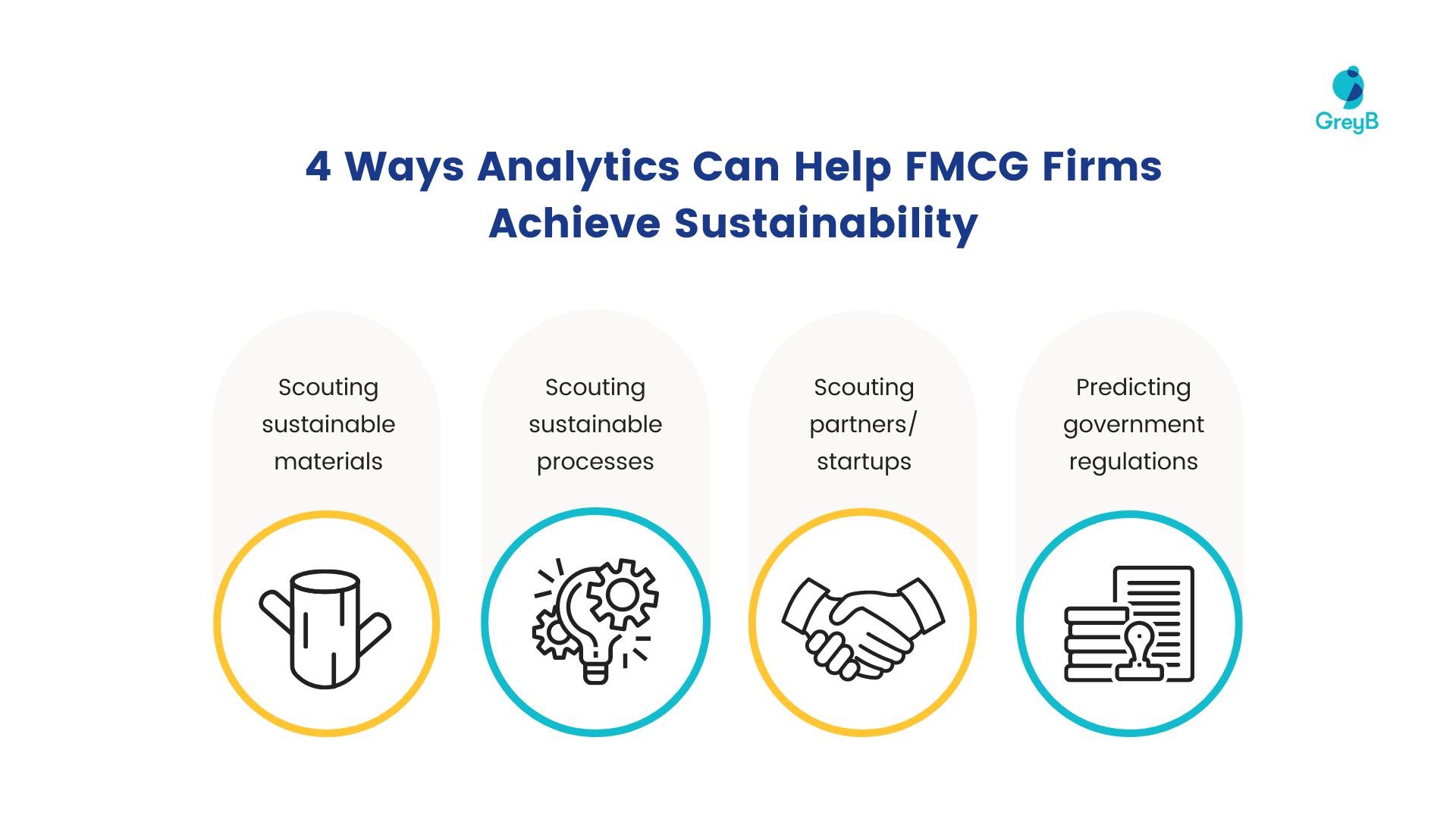
1. By scouting sustainable materials
As businesses strive to integrate sustainable materials into their supply chain, they constantly seek viable alternatives. Using analytics, FMCG companies can gain insight into sustainable packaging materials.
This includes exploring different technology readiness levels, from commercialized to research and pilot scale, for options like carbon-negative packaging, paper-based solutions, recyclable packaging, and plastics made from recycled materials.
Notably, companies are not limiting their search to their own industries; they are also eager to explore cross-industry solutions for carbon-negative materials.
How GreyB scouted Eco-Friendly materials for Equipment and Packaging
GreyB assisted two FMCG giants in sourcing sustainable materials for equipment and packaging. Our analysis evaluated diverse market materials (like research studies, brochures, webinars, awards, veteran interviews, market reports, and customer reviews) and patents and analyzed their upfront and operational costs.
We further analyzed the cost difference in energy consumption by comparing the different types of available materials (polyurethane, Fumed Silica, Glass Fiber, Polystyrene, etc.). After considering energy consumption over its lifespan, we identified a higher upfront cost material that offered the lowest operational expenses, potentially saving millions!
2. By scouting sustainable processes/ technology
Analytics proves to be an essential tool for identifying technologies aligned with companies’ carbon neutrality goals. Using this, firms can efficiently pinpoint existing and upcoming sustainable technologies suitable for integration into their supply chains.
Moreover, analytics can help you find solutions to enhance the sustainability of existing technologies, leading to reduced energy consumption and a decreased carbon footprint.
How GreyB identified sustainable milk processing methods
GreyB worked with a famous dairy giant to find sustainable milk processing methods. Our analysis uncovered research-backed models, including pinch analysis and exergy analysis, for identifying areas in the processing line with scope for energy efficiency improvements where new systems can be integrated. Additionally, we interacted with equipment suppliers and gathered data. We then sought patterns to verify claims, capacity, and cost of available equipment by contacting the equipment provider. Further, we analyzed the available customer reviews compiled from our research. And recommended a list of systems to help the client become more energy efficient.
3. By scouting startups/ partners
Through analytics, FMCG firms can identify potential partners for collaboration, licensing, or acquisition to enhance their sustainability efforts. These partners can range from technology providers to material suppliers. Analytics empowers food and beverage companies to efficiently search for partners offering sustainable solutions with minimal impact on their product’s sensory and nutritional profile by discovering and analyzing meaningful patterns in the available data.
Moreover, innovation managers can make strategic decisions when selecting technology providers, considering multiple factors, including public perception regarding the technologies offered, technology transparency, and the process’s environmental impact. Companies even employ analytics to avoid partnering with recycling solutions that aren’t transparent enough and use hidden toxic chemicals.
Additionally, companies can discover innovative startups and partners that share their vision and commitment.
How GreyB shortlisted potential startups for collaboration to enter a new domain
GreyB helped a famous food and beverage company enter the recycling domain by partnering with a recycling company. Our analysis began with understanding the local recycling ecosystem and its regulations. We then gathered case studies showcasing successful partnerships within the domain. We identified these partnerships using various sources such as press releases, articles, reports, annual reports, and news. Additionally, we pinpointed potential startups for collaboration by evaluating the technologies used by them for recycling as well as their market activities on prior partnerships.
4. By scouting present and predicting future government regulations
As governing bodies increasingly prioritize sustainability, they actively develop policies to promote eco-friendly practices. In response, FMCG companies are turning to analytics to understand and track these regulations.
Moreover, analytics provides valuable insights into a country’s infrastructure, assisting businesses in identifying opportunities and challenges for sustainable operations. Additionally, analytics aids in identifying relevant sustainability certifications for products in specific jurisdictions.
By leveraging this data, companies can stay well-informed about present and future government regulations, ensuring compliance and supporting environmentally responsible initiatives.
How GreyB predicted future packaging strategy as per the upcoming recycling regulations
GreyB aided a food and beverage giant comprehend recycling regulations across various regions. We identified current and forthcoming policies that governed the recycling ecosystems, enabling strategic packaging decisions aligned with each jurisdiction. For instance, in certain geographies, recyclable packaging materials are not promoted [which is against the market trend] because of poor recycling infrastructure. These geographies are rather promoting reusable materials. We identified various regions and analyzed how the upcoming government regulations will impact them. With these insights, the company was able to alter its packaging to stay a step ahead and comply with those regulations.
Conclusion
From understanding market trends to optimizing resource utilization and measuring the impact of sustainability initiatives, analytics is invaluable in driving positive change and fostering environmentally responsible practices.
As the pressures to commit to environmental sustainability and social responsibility mount, the use of analytics is expected to grow significantly.
However, navigating sustainability complexities, from supply chains to carbon footprints, often requires specialized insights. That’s what GreyB can help you with!
Want to optimize your sustainability efforts using analytics? We can help.

Authored by: Vanshika Sood, Patent Analytics and Ridhima, Marketing
Next Read: 5 Sustainable Alternatives to PFAs in food packaging that comply with the US & EU bans