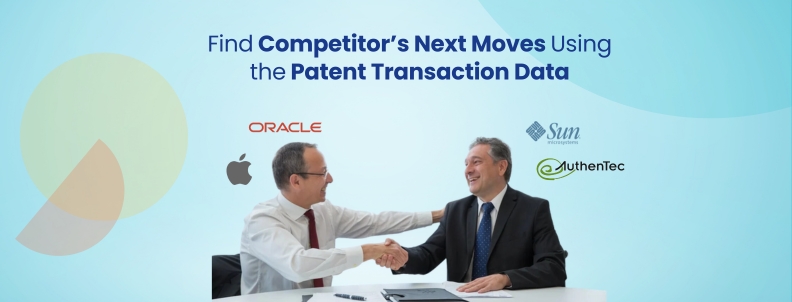


Mergers and acquisitions (M&As) often dominate headlines, but the role of intellectual property (IP) though crucial, is often overlooked. IP can influence industry competition and innovation, and it can make or break a successful acquisition. A closer examination of significant M&A cases, such as Tata Motors’ acquisition of Jaguar and Land Rover (JLR) and Oracle’s takeover of Sun Microsystems, underscores the crucial role of patent rights.
In the case of Tata Motors’ acquisition of JLR, their strategic approach focused on obtaining a license for JLR’s designs, allowing them to capitalize on market opportunities and expand their offerings. On the other hand, Oracle’s purchase of Sun Microsystems involved securing the firm’s patents, thus enhancing its technology portfolio and industry position.
These examples highlight that each M&A deal is unique, with distinct motives surrounding patent ownership. Patent transaction data becomes indispensable in unraveling such insights and understanding the acquirer’s intentions fully.
This article reveals how the patent transaction data of a competitor can provide companies with a technological edge and assist them in strategizing their future business ventures.
So, buckle up as we dive into the world of patent transactions and see how this data can reveal stories, trends, and opportunities for you and your domain.
1. Apple’s Strategic Acquisition of AuthenTec for fingerprint sensor
In February 2013, AuthenTec transferred its patents to Apple Inc as part of the acquisition. This acquisition aligned with Apple’s long-standing focus on fingerprint technology, which it had been developing since the late 2000s.
But, two years before Apple, Motorola was the first to offer a fingerprint sensor on its Mobility Atrix 4G in 2011. However, it wasn’t much effective and never got the required traction.
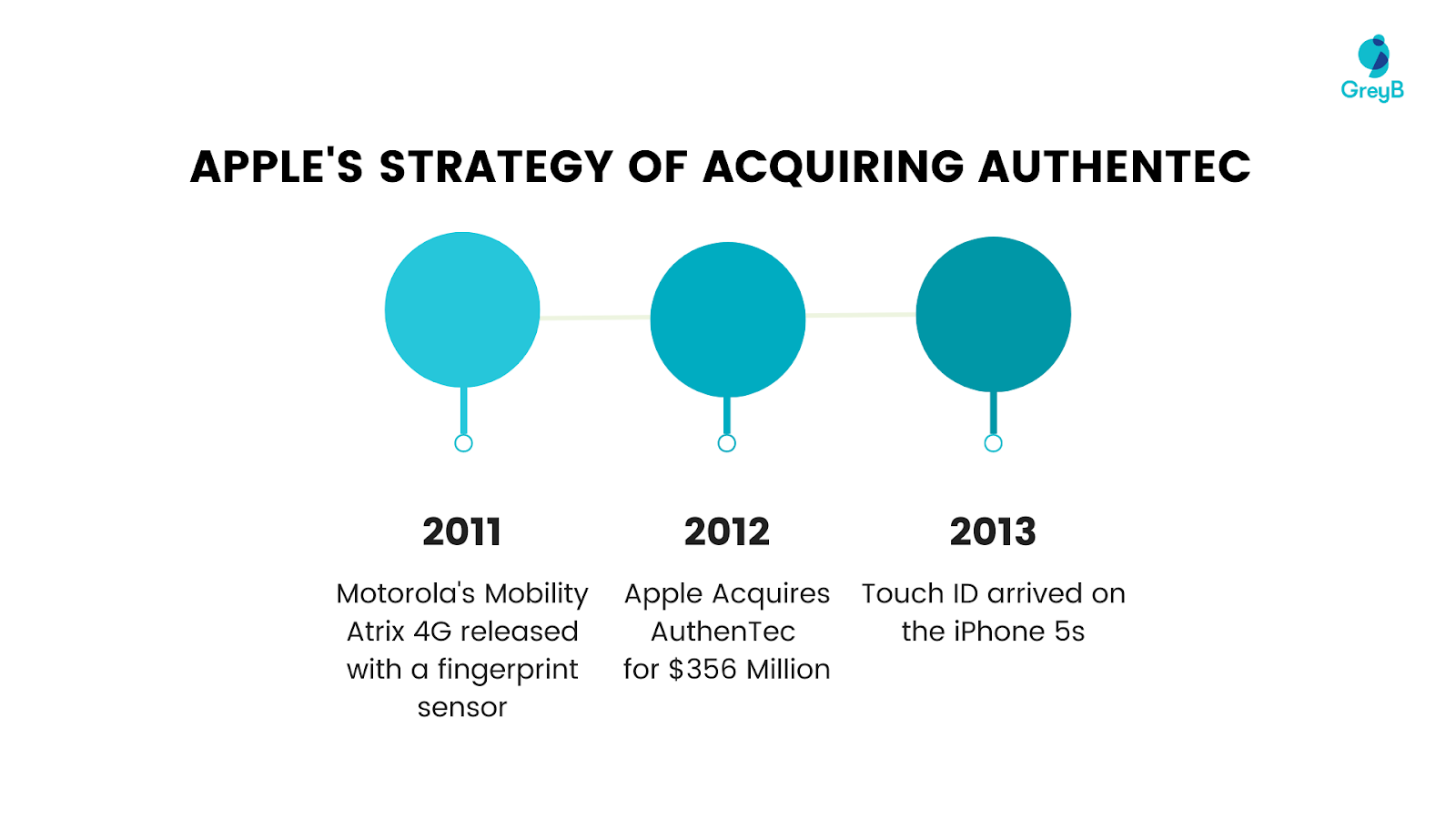
Eventually, by leveraging AuthenTec’s patents, Apple pursued its vision of integrating fingerprint scanning with face or eye recognition (Retina recognition) to enhance security measures. This breakthrough significantly bolstered security and user identification across Apple’s devices.
Notably, Dale R Setlak, Co-Founder and VP of Research at AuthenTec, was solely credited by Apple for envisioning the touch screen concept that incorporated high pixel sensing circuitry for coupling electrodes and pixel sensing traces.
If other players in the industry had monitored Apple’s transactions and developed or acquired a superior fingerprint technology before Apple released it on their phones, they could have gained a competitive advantage in the market.
While competitors like Samsung also ventured into fingerprint sensor technology, Apple’s acquisition of AuthenTec gave them a distinct advantage, catapulting their development in this field.
2. Acquisition of Sun Microsystems by Oracle to rival IBM.
In 2011, Sun Microsystems was acquired by Oracle. But why was this acquisition brought forth?
Oracle lacked a strong presence in the hardware market and wanted to expand its product offerings beyond software. Acquiring Sun Microsystems allowed Oracle to enter the hardware industry and strengthen its position as an end-to-end technology solutions provider. The acquisition strengthened its competitive position against other tech giants, such as IBM and HP, who also offered end-to-end hardware and software solutions.
Understanding the specific domains in which Oracle sought to expand its patent portfolio would have enabled competitors to tailor their own R&D strategies accordingly, either by investing in similar areas or by focusing on complementary technologies.
By exploring other patents in similar domains that were still available for acquisition, competitors could have strategically invested in technologies that expanded their market position and enabled them to compete more effectively against the combined Oracle-Sun entity.
3. Intel’s acquisition of Infineon to enter into competition with Qualcomm.
In 2011, Infineon sold its wireless division to Intel. In this process, several useful patents were also transferred.

Intel, before 2011, was looking for baseband chipset-related technologies to diversify its product offerings. Post-acquisition of Infineon, Intel integrated the GSM technology and went uphill against players like Qualcomm, who had an enviable dominant market position, owning half the mobile processor shipments and virtually all of the LTE/4G baseband chipset shipments. Source.
Intel integrated Infineon’s baseband technology into its own processors from late 2011 to early 2012’s. The integration allowed Intel to enter the smartphone market by offering a complete system-on-a-chip solution for mobile devices.
In mid-2012, Intel doubled down on LTE/4G when it opened a new office in San Diego, Qualcomm’s home territory, with the express intent of recruiting from the area’s deep pool of baseband talent to build a new modem design team for LTE/4G technologies.
This strategic move served as a valuable addition to Intel’s existing connectivity portfolio, bolstering its overall offerings in this domain.
Conclusion
Patent ownership changes often go unnoticed but can provide insight into a company’s investment in innovation, technology acquisitions, and expansion strategies. It enables you to explore other patents in similar domains and strategically acquire assets to strengthen your position in the industry.
However, navigating the complexities of patent transactions and performing due diligence requires expertise. That’s where GreyB’s services come in. We provide comprehensive patent intelligence and guide you through the due diligence process.
Unlock the power of patent insights for competitive analysis today by clicking on the button below.
Authored by: Annie Sharma, Mayank Maloo, and Jogeshwar Singh