


In the chemical domain, freedom-to-operate (FTO) risk extends far beyond what is immediately visible from a product’s composition or a process flow diagram. Unlike mechanical or electronic inventions, where infringement analysis is often confined to directly claimed structural or functional features, chemical products and processes operate within a highly interconnected ecosystem. At the same time, every FTO review is shaped by practical boundaries.
These include where the product will be sold, which patents remain in force, and how the product or process will be used at scale. Not every theoretical risk translates into a real-world concern. Raw materials, intermediates, inherent material properties, processing equipment, and even performance parameters can independently create infringement exposure.
A manufacturing process may appear clear from a conventional FTO perspective. However, if an intermediate compound, a specific raw material, or a piece of process equipment is covered under an existing patent, that element alone can pose the same level of risk as the core process itself. These blind spots often manifest as false negatives, risks that remain invisible until a product is already in the market.
Identifying and mitigating such hidden exposure is therefore critical in chemical FTO assessments. The following sections outline strategies that enable a more accurate, comprehensive, and defensible evaluation of FTO risk in chemical manufacturing and material development.
Also Read:

Strategies for Identifying Blind Spots in Manufacturing Process–Related Searches
1. Identifying Specific Materials and Equipment in the Process
In chemical patents, process claims are often drafted narrowly to facilitate examination. Meanwhile, related claims, sometimes within the same patent family and sometimes in separate filings, are used to secure control over essential components such as reactors, catalysts, heat transfer equipment, or material-handling systems.
The risk is not that these elements are unknown or forgotten. Rather, they are frequently treated as part of the manufacturing setup and assumed to be non-issues during FTO review. In practice, these components are often where infringement arguments are easiest to make, because they are concrete and identifiable and less sensitive to variations in process conditions. In practice, the key question is not whether equipment has ever been patented, but whether there are active claims that still matter in the markets where the product will be made or sold.
As a result, overlooking equipment- or material-specific claims can undermine an otherwise clean process-level clearance.
For example, in one of our recent cases related to a coffee manufacturing process, the invention involved a specific type of heat exchanger (scraper type) in which the process was carried out. Therefore, in addition to analyzing the overall process, we also examined whether the specific heat exchanger was patented or a well-known piece of equipment used in the art. From here, we identified Free-to-use (FTU) patents (evaluated based on expiration timing and jurisdiction coverage) for this heat exchanger, which helped our client confirm the equipment is well-known and used, rendering it free to use.
We found an expired patent disclosing the use of such a type of heat exchanger in coffee making – US3653929A. In similar assessments, it is also important to confirm that no later patents cover modified versions or improvements of the same equipment, as these can reintroduce risk even when earlier patents have expired.
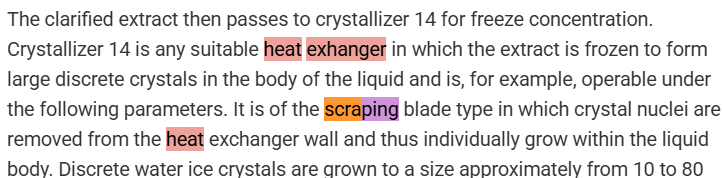
The value of this step is not completeness. It is risk control, removing an enforceable claim surface that could otherwise undermine an otherwise clean process analysis.
2. Evaluating End-Product Properties and Composition Separately from the Process
In chemical enforcement, product claims are often asserted when process infringement is difficult to prove. As a result, end-product analysis is treated as a parallel track rather than a secondary check.
In the coffee example, key product characteristics, caffeine percentage, moisture content, and flavor profile, were incorporated into the search strategy to evaluate whether existing claims could capture the final product itself. While no product-level threats were identified in that case, similar omissions have resulted in infringement findings elsewhere.
For example, in Syngenta v. Willowood (azoxystrobin), Willowood manufactured the end product outside the US but imported it into the US for sale. The patentee (Syngenta) had process patents for manufacturing the fungicide azoxystrobin (two-step method using a specific catalyst). The accused (Willowood) manufactured the compound abroad and imported the product (or sold a product made abroad). The case considered § 271(g) (U.S. law), which covers importation or sale of a product made by a patented process.
Another example is Mylan Institutional LLC v. Aurobindo Pharma Ltd. This case involved chemical-process patents (for the manufacture of the compound isosulfan blue) and the doctrine of equivalents. Although the process claims were under scrutiny, the court reversed a finding of infringement under the doctrine of equivalents for one process patent (because the accused process used a different oxidising agent than the claimed one). But the end‐product compound was yet found infringing via a separate compound claim. This led to the manufacture and sale of their ISB being enjoined.
Also Read:

3. Using Non-Patent Literature to Isolate What Actually Matters
Non-patent literature is not used simply to locate prior art. Its practical value lies in establishing what steps are routine and therefore unlikely to form the basis of a credible infringement theory.
Chemical patents often rely on narrow parameterization of otherwise conventional processes. Without filtering, an FTO search can spread effort across steps that are unlikely to matter in enforcement.
Consider a process for manufacturing an aluminum alloy (Al–Mn–Mg–Si–Cu–Fe–Zn–Ti–V–Ga) for cans, lids, and tabs:
- Melting/alloying
- Casting
- Hot rolling
- Cold rolling (~50% thickness reduction)
- Annealing (~300 °C for ~1 hour)
- Forming
Reviewing non-patent literature such as Recent progress of Al–Mg alloys: Forming and preparation process discloses the general sequence (alloying → casting → rolling → heat-treatment → forming) for Al–Mg alloys, you can treat the broad “melting/alloying”, “casting”, “hot-rolling” and “forming” steps as routine/known.
The steps “cold-rolling ~50%” and “annealing ~300 °C for ~1 h,” however, are more specific. Even though the NPL shows rolling and heat treatment generally, the specific parameters (50% reduction, 300 °C/1 h) may not be explicitly recited, and thus those steps remain candidate high-risk for patent claims.
Strategies That Can Be Used to Identify Blind Spots in Composition-Related Searches
Composition-focused FTO searches are often treated as relatively straightforward exercises: identify claimed elemental ranges, compare them against the target composition, and assess overlap. In practice, this approach captures only a portion of the real risk.
The strategies below address areas that are frequently overlooked, not because they are unknown, but because they fall outside the default scope of many composition-driven reviews.
These gaps tend to become more visible during scale-up, when laboratory concepts are translated into stable, repeatable manufacturing processes.
Also Read:

1. Focusing on the Backend Process Along with Material Composition
Composition-focused FTO searches typically concentrate on elemental ranges, ratios, and claimed formulations. Once a material appears compositionally distinct, the analysis often stops there. This approach assumes that risk is primarily defined by the material itself, rather than by how it is made. In practice, this assumption breaks down frequently in chemical and materials patents.
Manufacturing process claims are often drafted broadly, with minimal parameter constraints, precisely because they are harder to design around at scale. As a result, even when a composition itself is not claimed, the process required to manufacture it in a commercially viable manner may fall squarely within an existing patent.
This is why backend process analysis becomes critical in composition-related FTO work, not as a completeness exercise, but as a way to test whether a “clear” composition can actually be practiced without infringement. Steps such as purification, finishing, or post-processing are often treated as routine, yet they frequently appear in patent claims and can create unexpected exposure.
To address this, composition searches are deliberately extended into manufacturing-related patent classes associated with the product. This includes targeting broader process steps that are typically assumed to be routine, such as homogenization, hot rolling, cold rolling, or annealing, in aluminum manufacturing using keyword-driven approaches. In addition, independent claims across related patents are reviewed to identify process claims that achieve the same end result through broadly framed steps. Portfolios from the same inventors or assignees are also examined, as process protection is frequently split across filings even when compositions appear unclaimed.
In one alloy-related FTO project, this approach surfaced patents claiming manufacturing methods with only minor limitations on temperature and processing parameters. EP3956489B1, for example, disclosed a manufacturing process for a similar alloy composition using broadly defined steps such as homogenization, hot rolling below 290 °C, cold rolling, annealing, and further cold rolling.
Composition-only analysis would not have flagged this risk, yet the process claims posed a realistic barrier to commercial production.
2. Incorporating Material Properties
Composition searches often rely on elemental ranges as the primary screening tool, treating material properties as supporting information. This approach reflects how materials are described in technical specifications, but not how many patents are enforced. In advanced materials patents, properties are frequently the invention, with composition serving only as one pathway to achieve them.
For this reason, properties such as ultimate tensile strength, temper, and elongation are analyzed as independent claim anchors. The risk is not limited to patents that recite standard industry thresholds. Greater exposure often arises from claims that define properties using non-standard correlations or equations, thereby expanding coverage across multiple alloy systems.
In the alloy case referenced earlier, independent analysis of mechanical properties revealed patents that would not have been identified through composition searching alone.
EP4394068A1, for example, claimed alloy compositions that do not satisfy a tensile-strength correlation that does not correspond to standard industry criteria. By anchoring protection to performance behavior rather than elemental limits, the claim captured a broader category of alloys than would be apparent from compositional review alone.
This type of claim structure is frequently overlooked because it does not align with how materials are typically specified or compared. Yet, it can form the basis of enforceable infringement arguments.
3. Careful assessment of claim interpretation (Markush structures, parameter ranges, etc.)
A single patent can claim a broad family of related compounds through a Markush structure, covering thousands of potential variations, including your specific molecule. Therefore, it is crucial to search by chemical structure rather than just by name.
Parameter ranges introduce a more subtle risk. In one assessment involving an aluminum alloy product that contained no zinc (Zn), initial assumptions suggested the product fell outside the scope of patents claiming Zn-containing alloys.
However, closer review revealed patents such as CN110129634B and US20220205072A1 that claimed alloy compositions using elemental ranges broad enough to encompass the product. Although these claims listed additional elements, such as Zn and Ti, they specified only an upper limit for each (e.g., less than X%).
Importantly, the claims did not define a lower bound.
As a result, the permitted range effectively ran from 0% to X%. Under this interpretation, a composition containing no Zn at all still fell within the claimed range, bringing the product squarely within the scope of the claims and creating a direct infringement risk.
This type of range-based interpretation is easy to overlook but often decisive. Correctly identifying when “optional” elements remain claim-inclusive can materially change the final FTO conclusion and, in some cases, reverse an assumed clearance position.
4. Using Standard Test Codes to Capture Material Properties
Property-based claims are not always expressed through descriptive keywords. In many cases, patents define material characteristics by reference to standardized test methods rather than explicit numerical values. When search strategies rely solely on property terminology, such claims remain invisible.
Including relevant test standards, such as ASTM, ISO, or CEN codes, addresses this gap by aligning the search with how claims are actually drafted. For aluminum alloys, adopting ASTM E8 enables identification of patents that define tensile strength through standardized testing rather than descriptive thresholds.
US11584977B2 illustrates this approach. The patent does not emphasize property descriptors in a way that conventional keyword searches would capture, yet it defines alloy strength explicitly by reference to ASTM E8 testing. Without incorporating the test standard, the claim would likely be missed despite its direct relevance.
Conclusion
Issues like the ones discussed above rarely appear in isolation. They typically surface during active development or scale-up projects, often when design decisions are already in motion, and timelines are fixed. At that stage, how claim language, parameter ranges, and historical disclosures are interpreted can directly impact feasibility and risk.
Each material system and manufacturing route brings a different combination of variables. What appears low-risk in one context can become exposed when process conditions, performance targets, or market jurisdictions change. For this reason, FTO analysis in chemical and materials domains is most effective when it is treated as a project-specific exercise rather than a standardized review.
We apply these strategies as part of our FTO analyses, adapting them to the specific composition, process, and commercial context of each case. If you are evaluating freedom to operate for a new material, modifying an existing process, or reassessing risk around a commercial product, a focused discussion with an FTO expert can help clarify the path forward.