Cosmetotextiles sit at the intersection of textile science, dermatology, and material chemistry, opening new IP spaces, collaborative development models, and evidence-based claim pathways that align with stricter regulatory and performance expectations. As sustainable carriers, skin-compatible actives, and responsive release systems mature, the key question is no longer feasibility, but how quickly organizations can industrialize, validate, and scale these platforms into differentiated product pipelines.
1. Market Landscape and Growth Drivers
The global technical textiles market is expanding from $213.8 billion in 2024 to $284.0 billion by 2029, with moisture-wicking fabrics, a key cosmetotextile segment, growing from $2.82 billion to $3.86 billion. Key drivers include:
- Post-pandemic wellness consciousness: Heightened health awareness driving demand for multifunctional textiles
- Athleisure market expansion: Growing intersection between performance wear and cosmetic functionality
- Eco-friendly product demand: Consumer preference for sustainable and biodegradable solutions
- Multifunctional textile demand: Integration of cosmetic benefits with traditional textile performance
2. Core Technologies and Mechanisms
Microencapsulation Advances
- Rate-determining release systems: Extended functional lifetimes from hours to weeks using advanced microencapsulation
- Dual-phase microcapsules: Distinct inner and outer phases enabling controlled release
- Temperature-sensitive walls: Responsive release mechanisms activated by body temperature or environmental conditions
Sustainable Application Methods
- Spraying technology: Lower water usage and chemical consumption compared to traditional exhaustion methods
- UV curing processes: Energy-efficient alternatives to thermal fixation, maintaining functionality
3. Functional Categories and Applications
Moisturizing Functionality
Recent innovations demonstrate measurable skin improvements:
| Technology | Key Ingredients | Performance Metrics |
|---|---|---|
| Ceramide microcapsules in viscose fibers | Ceramides | Long-lasting moisturizing effects |
| Vitamin E microcapsules | Vitamin E with β-cyclodextrin | Enhanced stability and release |
| Shea butter encapsulation | Shea Butter with ethyl cellulose shells | Moisturizing denim applications |
| Commercial moisturizing textiles | Multiple active agents | 35.1% elasticity increase, 30.7% roughness reduction |
Anti-Aging Functionality
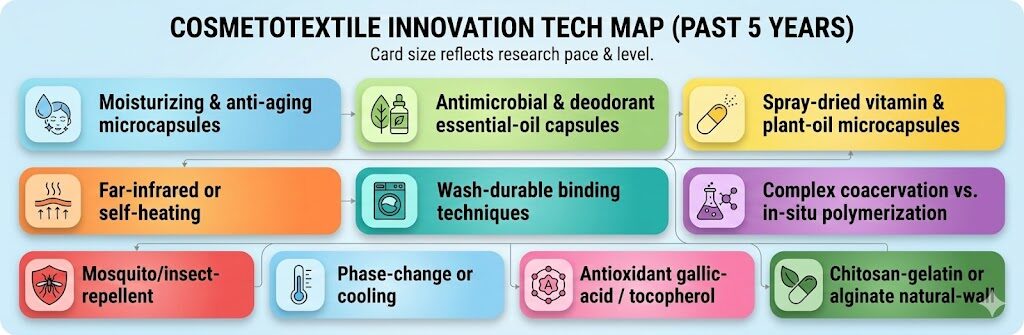
- Retinol nanocapsules: Chitosan-coated for improved stability and skin penetration
- Botanical extracts: Polygonum extract microcapsules providing free radical scavenging and whitening effects
- Heat shock protein activation: Peony extract microcapsules for cellular protection
- Marine-based actives: Padina Pavonica integration for skin firmness and elasticity
Antimicrobial Functionality
Essential oil encapsulation represents a major growth area:
| Active Compound | Encapsulation Method | Bacterial Reduction | Durability |
|---|---|---|---|
| Cinnamon oil | Polymer nanoencapsulation | >97% against S. aureus and E. coli | 10+ wash cycles |
| Lime peel essential oil | Chitosan-alginate microcapsules | Broad-spectrum antimicrobial | Maintained effectiveness |
| Multiple essential oils | Various encapsulation methods | >97% bacterial reduction | 5-10 wash cycles |
Thermo-Regulating Functionality
- PCM microcapsules: Phase change materials for temperature regulation
- Cooling microcapsules: A Combination of isopiperitol, methoxypropylene glycol, and menthyl lactate providing biological cooling sensations lasting nearly 1 hour
- Multifunctional systems: UV protection combined with thermoregulation using polylactic acid-chitosan composite walls
4. Regional Market Dynamics
Asia-Pacific Leadership
- China: Pioneering microencapsulation technologies with extensive patent filings
- South Korea: Focus on germanium-infused functional textiles
- Taiwan: Advanced microcapsule carrier structures
European Sustainability Focus
- Germany: Skin patch technologies and medical applications
- Spain: Polyurethane resin-coated microcapsules for enhanced durability
5. Emerging Trends and Innovations
Sustainability Revolution
- Biodegradable microcapsules: Natural polymers including chitosan, alginate, and plant-based materials
- Green extraction methods: Moving away from fossil-based components
- Recyclable adhesion systems: Enabling multiple use cycles
Advanced Delivery Systems
- Double-walled microcapsules: Enhanced stability and controlled release profiles
- Nanoencapsulation techniques: Improved bioavailability and skin penetration
- Complex coacervation: Robust microcapsule systems with temperature-responsive properties
6. Commercial Challenges and Solutions
Durability Improvements
Early cosmetotextiles suffered from rapid functionality loss. Recent innovations address this through:
- Advanced crosslinking agents extending wash durability to 5-10 cycles
- UV curing processes maintaining effectiveness through multiple launderings
- Improved adhesion systems preventing active ingredient loss
Safety Considerations
- Natural, biocompatible materials minimizing skin irritation
- Hypoallergenic formulations for sensitive skin applications
- Regulatory compliance across multiple jurisdictions
7. Future Outlook
The sector is growing at 9% CAGR, driven by post-pandemic hygiene awareness and wellness apparel demand 20. Key developments include:
- Wearable technology integration: Smart textiles with programmable release profiles
- Precision delivery systems: Multi-functional microcapsules offering precise control over release rates
- Personalization: Customizable cosmetotextiles based on individual skin types and needs
The convergence of sustainability demands, advanced delivery technologies, and multifunctional performance requirements positions cosmetotextiles for continued robust growth across multiple application segments.