

Menthol is famously known for adding freshness to foods. But when used in excess, it numbs the mouth, carries a strong odor, tastes bitter or sharp, and can irritate the skin. It also tends to form clumps or crystals during mixing, leading to inconsistent cooling effects and uneven flavor intensity. As the demand for more versatile ingredients rises, industry leaders seek menthol alternatives that offer improved performance without these drawbacks.
Several menthol alternatives have emerged, offering greater benefits, including being 100% renewable and possessing enhanced cooling properties. This report examines menthol alternatives as cooling agents in foods and beverages. These also ensure easier mixing and better dosing precision, eliminating issues such as clumping and static.
Promising menthol alternatives at a glance
| Cooling Agent | Key Benefits |
| Symcool® Extra WSE-500 | Enhanced cooling, improved handling, and versatile applications. |
| MINTACT | Bio-based, subtle aroma, cost-effective. |
| L-Menthol FCC | Approved by JECFA, EU-REACH, and FEMA, sustainable, versatile blending. |
| Menthol Ether Cinnamic Acetal | Extended cooling duration, reduced irritation, innovative composition. |
Symcool Extra WSE-500: Odorless blend that mixes easier than Menthol
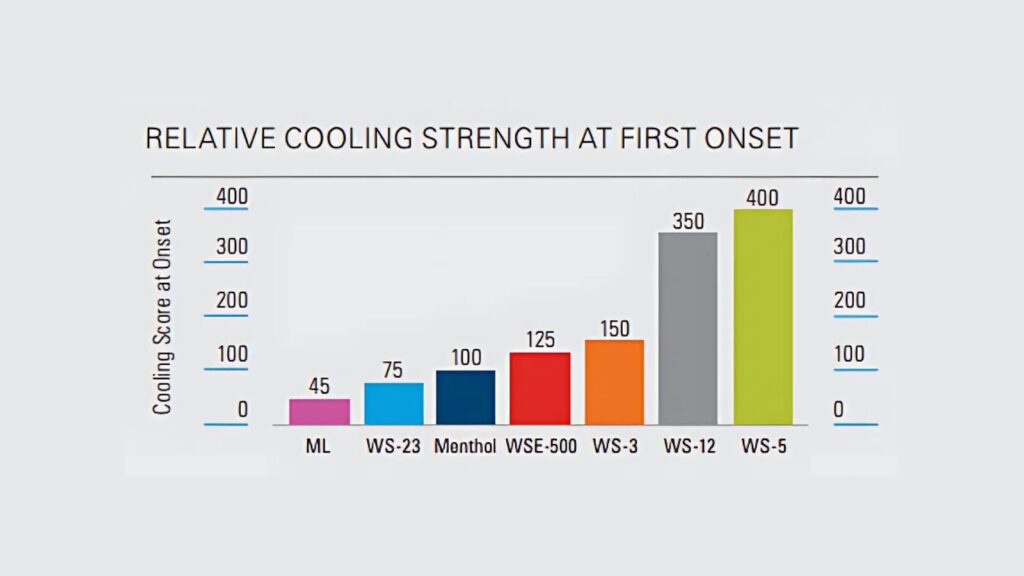
Symcool Extra WSE-500 is a patented liquid blend with enhanced cooling intensity and longevity compared to menthol. It also addresses challenges such as menthol’s odor and its high volatility. Additionally, menthol can form clumps or crystals during mixing, resulting in inconsistent cooling effects and flavor intensity throughout the product. This new blend mixes more easily, allowing manufacturers to get the desired cooling effects without such issues.
Its liquid format improves dosing precision and reduces dusting and static issues common with crystalline coolants, making it safer and cleaner to handle in lab and production environments.
While specific regulatory approvals are not detailed, its composition suggests that it may be subject to flavoring regulations, such as those established by FEMA and JECFA. The scalability of the WSE-500 depends on the availability of its constituent compounds, particularly WS-3, WS-23, and menthyl lactate. Also, WSE-500 is a proprietary liquid blend. It’s produced in limited facilities equipped with specific equipment for solvent-free, homogeneous mixing. This production constraint may pose challenges when scaling.
Relative cooling strength WSE-500 as compared to existing WS cooling agents and menthol:
The components that contribute to its cooling effect are:
1) Methanecarboxylic acid amides: These compounds have a menthol-like structure and are modified to enhance their cooling properties and reduce bitterness.
2) Enantiomers: Menthol compounds’ specific enantiomers (mirror-image forms) have superior cooling effects. For example, the (R)-enantiomer provides a stronger cooling sensation than the (S)-enantiomer.
It combines the cooling sensations of various cooling agents, such as menthyl lactate, menthone glyceryl acetal, menthone glyceryl ketal, WS-3, and WS-23, creating a synergistic effect that enhances overall cooling sensation and duration. Additionally, lab tests found that WSE-500 delivers a balanced, long-lasting cooling effect without the sharpness or bitterness often associated with WS-23-heavy blends. It meets the requirements of Food Safety System Certification 22000.
The applications for this product include mints, gums, candies, soft drinks, energy drinks, and alcoholic beverages. Symrise is the supplier of these products.
MINTACT: a mint-flavored oil that resists environmental factors
MINTACT is developed using aroma analysis technology, with ingredients such as L-menthol produced through asymmetric synthesis. Mint oil quality usually varies due to weather conditions, pests, and regional differences, leading to fluctuations in aroma and potency.
MINTACT uses microencapsulation to protect its active cooling agents from humidity, oxygen, and light, which can degrade menthol and similar compounds. This ensures consistent quality, unaffected by environmental factors. Therefore, it can serve as a substitute for mint oil as a key ingredient in mint-flavored products.
It is made from 100% bio-based and renewable ingredients, such as l-menthol. Compared to conventional menthol, it has a subtle aroma and is more affordable. It also maintains a stable supply, as it is not dependent on crop yields. It has received certification as a 100% bio-based BioPreferred® product by the USDA..
The applications for this product include savory dishes, beverages, dairy products, confectionery, and bakery items. Taksako is among its leading suppliers.
Finding information on new menthol alternatives using standard Google search queries can be tedious. You’ll have to manually sort through hundreds of search results to find a product with the desired qualities. Additionally, these results may not always include patented inventions that match your needs. That’s where an innovation-sourcing tool like Slate comes in handy.
You just need to ask a question, like ‘What are the latest menthol alternatives for foods?’ Slate will scour research papers, patents, and market data across multiple languages to produce highly relevant results. Here’s an example:
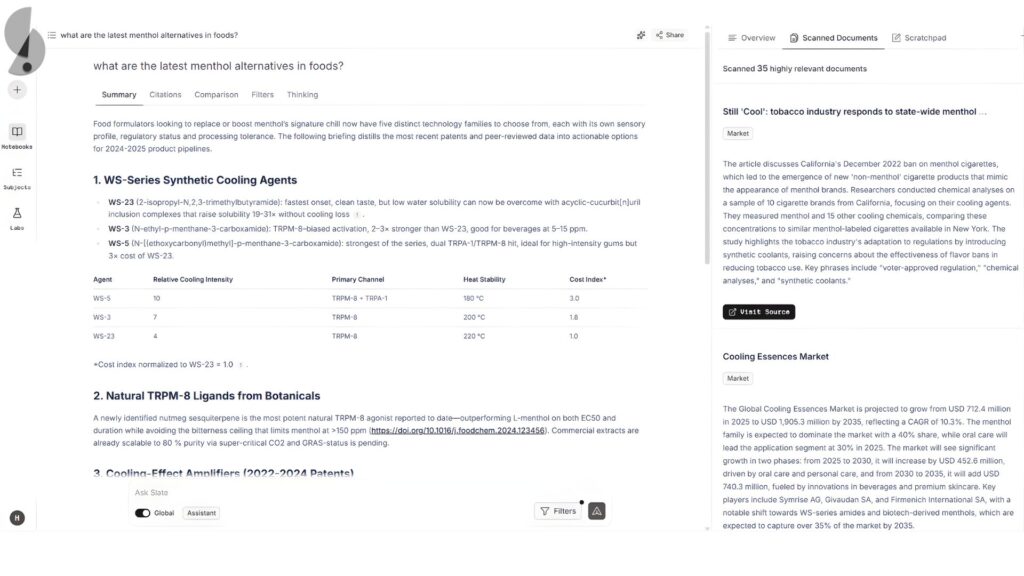
Slate also lets you “chat” with these papers to get more information easily. Try it out yourself below!
what are the latest menthol alternatives in foods?
L-Menthol FCC: Longer-lasting cooling sensation with lower carbon footprint
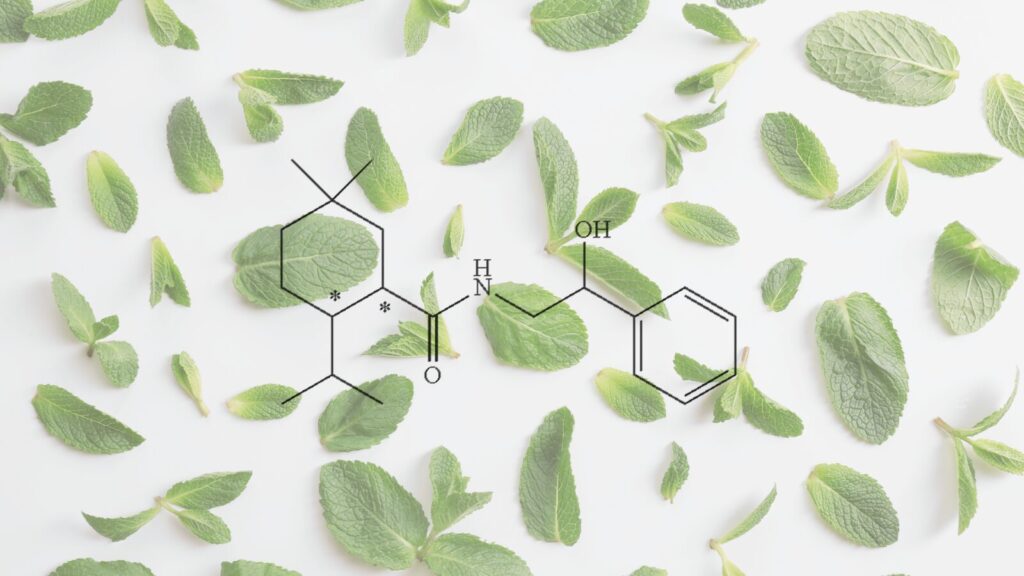
This menthol alternative has a characteristic minty scent that provides a fresh, cooling sensation. It is versatile and blends well with other mint elements, such as Menthyl Acetate and Menthone. Additionally, it is biodegradable, has a lower carbon footprint of 8-15 kg CO₂e/kg, and is approved by JECFA, EU-REACH, and FEMA.
Here’s how it works:
- Receptor activation: It activates the TRPM8 ion channel, which is a cold and menthol receptor. This ion channel is part of the sensory nerve endings that detect cool temperatures and signal the brain.
- Prolonged effect: The derivative’s structure enables sustained receptor interaction, resulting in a longer-lasting cooling effect than traditional menthol.
- Reduced sensory irritation: By optimizing the chemical structure, this derivative mitigates the irritation and strong odors often associated with pure menthol, providing a gentle yet effective cooling experience.
Here are some similar products to consider:
| Compound | Description | Compared to L-Menthol FCC | Pros | Cons |
| DL-Menthol FG | Racemic mixture of D- and L-menthol | 50% overlap with L-menthol | Cost-effective, milder cooling, broader availability | Less potent cooling, may have off-notes, not always label-friendly |
| L-Isopulegol FG | Precursor to L-menthol in synthesis | Structurally similar, herbal-minty | Fresh, herbal profile; good for synthetic mint oil reconstruction | Less cooling, more volatile, not a direct menthol substitute |
| (1R,2S,5R)-L-Menthol | Pure stereoisomer (same as FCC) | Chemically identical | Same cooling and flavor profile | Only differs if not FCC-certified (i.e., not food-grade) |
Global confectionery and gum brands, such as Mondelez, Perfetti Van Melle, and Mars Wrigley, which rely on consistent, clean mint profiles in products like chewing gum, mints, and lozenges, use L-Menthol FCC.
Menthol ether cinnamic acetal(MECA): Menthol-like freshness with improved aroma for tobacco use
This cooling agent is similar to Symcool Extra WSE-500 but has aromatic properties. It provides a toned-down yet natural fragrance that addresses the strong odour often caused by menthol. Additionally, MECA can be tailored for tobacco use, whereas the WSE-500 is designed for general cooling.
Specific regulatory approvals for this compound are not readily available. Its novel composition may require thorough safety and efficacy evaluations before it is introduced to the market.
MECA is made by combining tiny silica balls with a special type of menthol. This mixture creates a cooling agent that is trapped inside the silica balls and then covered with tannic acid. It offers sustained release, extended cooling time, enhanced durability, and a pure cooling taste with minimal unpleasant sensations.
Mianyang Simaiergu Biotechnology manufactures MECA. It can be used as a cooling additive when a menthol-like fragrance is desired, such as in foods and cosmetics, including aftershaves, lotions, or perfumes.
Conclusion
While all the alternatives offer clear advantages over menthol, such as longer-lasting cooling, subtle aromas, and improved sustainability, their scalability will depend on establishing stable supply chains and efficient manufacturing processes.
The next step for industry leaders is to evaluate the commercial viability of these menthol alternatives for their specific products and goals. An in-depth landscape analysis can enable R&D leaders to assess the scalability, regulatory compliance, and market readiness of each alternative, thereby pinpointing the most promising options.
Please share your query in the simple form below to receive expert assistance.