
Tackling Inefficient Packaging and Product Wastage in Viscous Liquid PET Bottles
A Fortune-500 F&B company faced a significant challenge of product wastage during packaging viscous liquid and semi-liquid food items in PET bottles. The issue originated from these products sticking to the container walls, leading to inefficient packaging and increased wastage. Recognizing the urgent need to address this issue and align with their global mission to eliminate food waste, the company conducted a study to identify effective slip additives for PET packaging.
The upper management sought cost-efficient solutions to avoid the expensive relocation of manufacturing plants and maintain their commitment to sustainability.
They prioritized additives that:
- Do not affect the product’s flow rate from the bottle
- Do not interfere with the existing bottle design
- Ensure compliance with FDA, EFSA, or equivalent regulatory standards
The evaluation criteria were strict, and finding relevant solutions was extremely challenging.
Identification of Slip-Enhancing Materials to Prevent Food Adhesion in PET Bottles
The company received a detailed analysis that identified materials suitable for adding to the preform, increasing the slipperiness of the PET bottles to prevent contents from sticking to the walls, ensuring easy removal.
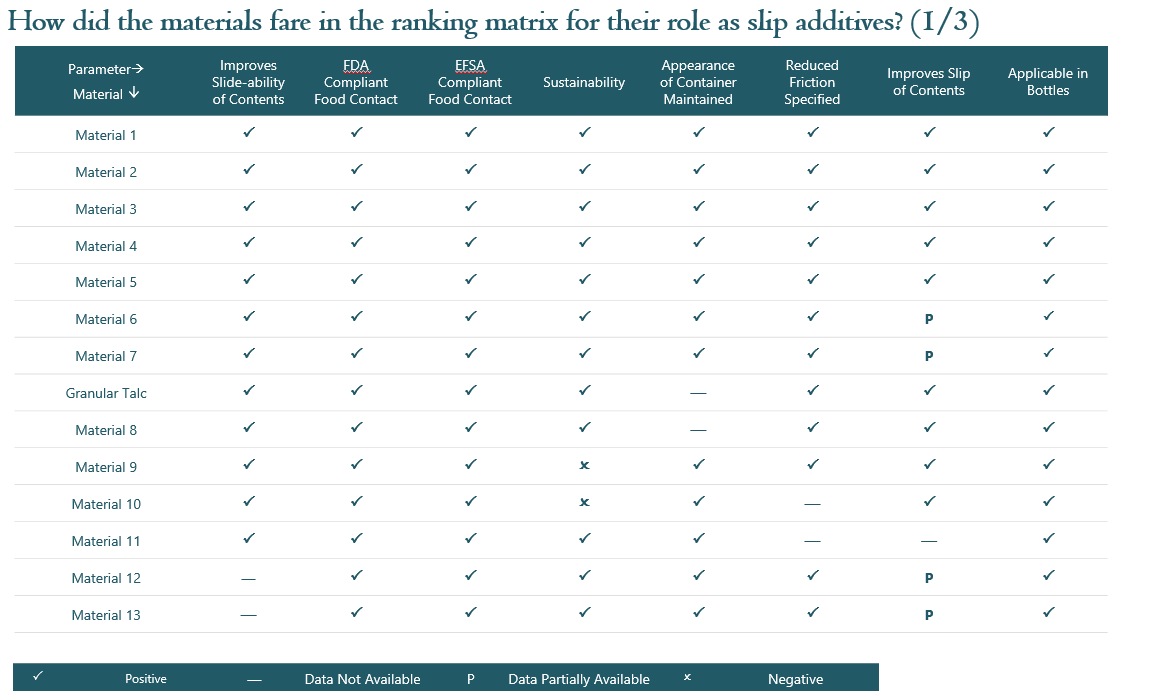
The analysis included specific solutions such as patented resin compositions and slippery polymer layers designed to minimize food adhesion.
Additionally, they gained insights into cross-industry additives, commonly used in oils and juices, that could be applied to PET bottles for viscous and semi-liquid food products..
Key Findings from the Analysis
A detailed list of solutions was provided based on strict evaluation criteria that matched the company’s needs. This included improving the slide-ability of the contents, FDA-compliant food contact, sustainability, etc. Some of them were:
Granular Talc from Mitsubishi Gas Chemical
A patented resin composition incorporating granular talc was identified for its excellent slipperiness. This formulation includes PET—a polyester containing dicarboxylic acid and diol units—enhanced with 0.01-20% granular talc. The result is a material with improved slide-ability, thermoformability, and heat resistance, making it highly suitable for use in food containers and packaging materials.
Slippery Polyester Chips from Nan Ya Plastics
This method, developed through recycling PET plastic waste, introduces slipping agents during the chemical recycling process to enhance the slipperiness of polyester films. Slipping agents such as silicon dioxide, calcium carbonate, and acrylic improve the handling properties of recycled polyester, contributing to a more sustainable packaging solution.
Research Process- How did GreyB Help?

Phase I: Literature Gathering
The process began with understanding the company’s domain and developing a tailored evaluation framework. Relevant literature, including patents and technical papers, was extracted and manually screened. Only the most relevant documents were selected for further analysis.
Phase II: Solution Evaluation
The identified literature was thoroughly analyzed, and solutions were categorized into three tiers based on their potential and readiness:
- Tier 1: Solutions ready for immediate implementation.
- Tier 2: Promising options that required further development.
- Tier 3: Lower-priority solutions with limited potential.
Phase III: Detailed Recommendations and SLATE Integration
A detailed analysis of the top five Tier 1 solutions led to final recommendations tailored to the company’s needs. These insights were then integrated into GreyB’s SLATE tool, which provided an interactive dashboard for them to explore findings, track solution performance, and make informed decisions efficiently. SLATE ensured a dynamic, user-friendly platform for continuously monitoring and exploring the recommended solutions.
The food and beverage packaging industry is challenged by sustainability demands, cost pressures, regulatory compliance, and the critical issue of food wastage. Inefficient packaging can lead to product spoilage, increasing food waste and reducing consumer satisfaction.
Transforming your packaging processes is key to tackling food wastage while staying competitive. Whether you’re improving packaging to extend shelf life, enhance sustainability, or ensure regulatory compliance, GreyB can help.
If you’re ready to reduce food waste, optimize your packaging operations, and overcome these challenges without costly investments, fill out the form below to connect with our experts today.